

Introduction
Agentic AI is transforming the enterprise. While traditional AI delivered insights and summaries, agentic AI goes further: it acts. These systems can update records, orchestrate workflows, route decisions, trigger alerts, and interact with employees or customers in real time.
That shift—from AI as an assistant to AI as an actor—demands far more from your organization’s technology environment. The question executives must now ask is not:
“How can we use AI?”
but rather:
“Is our environment ready for AI agents to operate safely, consistently, and at scale?”
Most AI pilots collapse not because algorithms fail, but because technology foundations are fragile, processes are undocumented, access is uncontrolled, and teams lack alignment.
This guide provides a platform agnostic, executive level framework for evaluating whether your organization is truly ready for agentic AI—across five pillars that determine whether AI becomes strategic… or dangerous.‑agnostic, executive‑level framework
What Does “AI Readiness” Really Mean?
“AI readiness” is often misinterpreted as “We have data in the cloud” or “We use collaboration tools.”
In reality, for agentic AI, readiness means:
- Your data is accessible but not overexposed
- Your systems are integrated but not tangled
- Your agents have permissions but not privileges
- Your operations are automated but still controllable
- Your people understand the technology but remain responsible
True readiness is the ability to deploy agents that can act autonomously—without compromising security, quality, compliance, or stability.
To assess that, we use five pillars.
The 5 Pillars of Agentic AI Technology Readiness
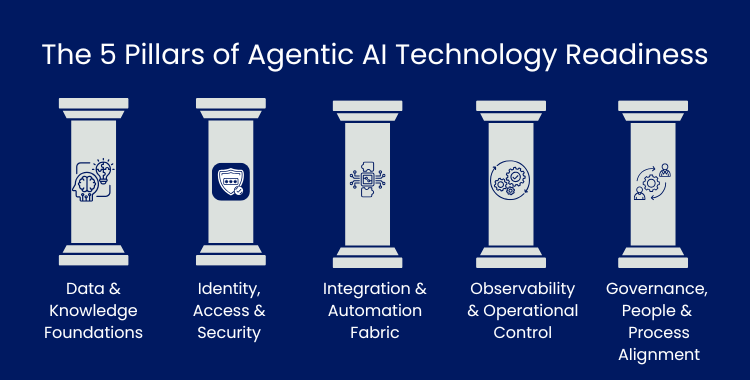
- Data & Knowledge Foundations
Agentic AI performs best when it can access structured, relevant information. Without clean inputs, you get inconsistent or incorrect outputs at scale.
Executives must understand:
AI agents amplify whatever data environment they inherit—good or bad.
Assess whether:
- Critical data sources are known, documented, and governed
- Sensitive data is segmented from general access
- Knowledge assets (policies, manuals, procedures) are stored in structured formats
- You can control which datasets and documents agents can see
If a human can’t perform their job using your data environment, an agent can’t either.
.
- Identity, Access & Security
In agentic AI, agents are doers, not passive tools—so they require identities, permissions, and constraints like human employees.
Executives should confirm:
- Agents have unique identities, not shared service accounts
- Permissions follow least privilege, not “give it access just to test”
- Access can be granted or revoked instantly
- MFA, conditional access, and role based controls apply consistently‑based controls apply consistently
- Security teams can see and evaluate agent activity patterns
If an agent is over permissioned, the organization is exposed.
If it’s under permissioned, the agent becomes useless.
- Integration & Automation Fabric
Agentic AI only creates business value when it can move information between systems, not inside single silos.
This requires an integration layer that is:
- Structured
- Governed
- Documented
- Scalable
- Secure
- Consistent across teams
Ask:
- Do we have standard APIs and integration patterns?
- Are we reliant on spreadsheets, exports, or email workflows?
- Do we allow teams to connect tools ad hoc?
- Is our automation layer (RPA, workflow engines, iPaaS) unified or fragmented?
Agents cannot operate reliably on top of chaos.
Readiness means your environment is interconnected without being tangled.
- Observability & Operational Control
You cannot manage what you cannot see. Observability is the most overlooked pillar.
Executives need:
- Dashboards showing active agents and their workloads
- Alerts for anomalies, errors, or high risk actions‑risk actions
- Activity logs that business leaders—not just engineers—can interpret
- The ability to pause, override, or rollback agents instantly
Observability is not optional. It’s your risk control layer.
- Governance, People & Process Alignment
Technology readiness collapses if people bypass guardrails or misuse agents.
Executives must ensure:
- AI use cases are formally proposed, evaluated, and approved
- Teams understand the boundaries of agent capabilities
- Policies define which processes can be automated and which require human oversight
- Training ensures teams know what to trust—and what to verify
- There is a named owner for every agent and automation
Readiness is not just technical. It’s an organizational discipline.
Common Failure Modes
Executives should watch for:
- Pilot sprawl: Every team runs its own AI experiments.
- Shadow agents: Undocumented tools connecting to sensitive systems.
- Over‑privileged access: “Just give it admin while we test.”
- Integration chaos: Agents relying on broken workflows.
- No operational visibility: Leaders flying blind.
- No steady owner: Everyone assumes someone else is managing it.
These aren’t technical issues—they’re leadership gaps.
Executive AI Readiness Checklist
Use this checklist in your next leadership meeting:
Data & Knowledge
- Do we know where key data and documents live?
- Are sensitive materials protected from agent visibility?
Identity & Access
- Does every agent have its own identity?
- Do we enforce the least privilege access?‑privilege access?
Integration
- Are core systems connected through standardized APIs?
- Are we eliminating manual workarounds?
Observability
- Can we monitor agent actions in real time?
- Can we pause or reverse agent activity?
Governance & People
- Do we have documented guardrails?
- Are teams trained on agent responsibility and oversight?
If you score low in even one pillar, your AI readiness is incomplete.
Your First 90 Days Toward AI Readiness
Weeks 1–2: Assess & Align
- Score each pillar on a 1–5 scale
- Identify top risks and dependencies
- Establish executive ownership
Weeks 3–6: Strengthen Foundations
- Clean up data access
- Fix permission issues
- Standardize your integration approach
- Build basic observability dashboards
Weeks 7–12: Pilot on Solid Ground
- Choose a high value, low risk use case value, low risk use case‑value, low‑risk use case
- Deploy agents with monitoring and governance
- Run a readiness retrospective and update your standards
Conclusion
Agentic AI accelerates performance, but only when deployed on a Ready foundation. Organizations that invest in readiness will scale confidently. Those that don’t, will scale risk.
A C-Suite Guide to Technology Readiness
👉 Download the Agentic AI Technology Readiness Scorecard and discover where your environment is ready—and where it’s exposed.