Introduction
The most powerful shift happening in global leadership today isn’t automation, efficiency, or even AI driven growth.
It’s this:
Executives are learning with AI — and over time, AI becomes an extension of their strategic mind.
Not as a “copilot.”
Not as a digital assistant.
But as a persistent, intelligent layer that understands how the executive thinks, what they prioritize, how they weigh risk, and how they make decisions.
This is the new frontier of leadership capability — where Executive Agents grow alongside the leaders they support and gradually become a second cognitive layer:
• more aware,
• more consistent,
• more data connected,
• more sentiment attuned,
• more risk sensitive,
• more strategically aligned
than any human team can be alone.
This is the final evolution of enterprise AI:
AI that thinks with the executive, not just works for them.
- The Cognitive Gap Every Executive Feels — But Doesn’t Say Out Loud
Executives are not overwhelmed by technology.
They’re overwhelmed by signal complexity.
Today’s leaders are forced to simultaneously track:
- Financial targets
- Operational KPIs
- Market movement
- Customer sentiment
- Internal sentiment
- AI agent output
- Execution risks
- Compliance and CPA relevant exposure‑relevant exposure
- Strategic integrity
- Cross functional dependencies‑functional dependencies
- Drift in initiatives, goals, and behavior
- Organizational morale and readiness
A decade ago, no leadership team was expected to process all of this in real time.
But now?
The organizations that win are the ones whose leaders make faster, clearer, higher quality decisions with far more complexity.
Human cognition alone can’t keep up.
Executives need intelligence that extends their thinking, not just reports their data.
This is precisely what Executive Agents provide.

Executive Agents as Cognitive Extensions of Leadership
Executive Agents act as digital extensions of the C-Suite — learning how each leader thinks, prioritizes, evaluates, and responds.
They don’t just analyze data.
They learn the executive’s internal model:
- Their preferred KPIs
- Their risk sensitivity
- Their financial philosophy
- Their strategic intent
- Their communication patterns
- Their decision frameworks
- Their sentiment sensitivity
- Their operational thresholds
- Their appetite for speed vs. caution
Over time, they become a personalized, evolving intelligence layer that feels less like a tool and more like:
- A strategic interpreter
- A decision quality amplifier
- A risk sentinel
- A sentiment radar
- A coherence engine
- A narrative builder
- A translator of signals into meaning
- A reinforcement partner for strategic alignment
This is where the technology becomes deeply personal:
The AI learns the executive. The executive learns with the AI. Together, they improve
How Executives Learn With AI (and AI Learns With Them)
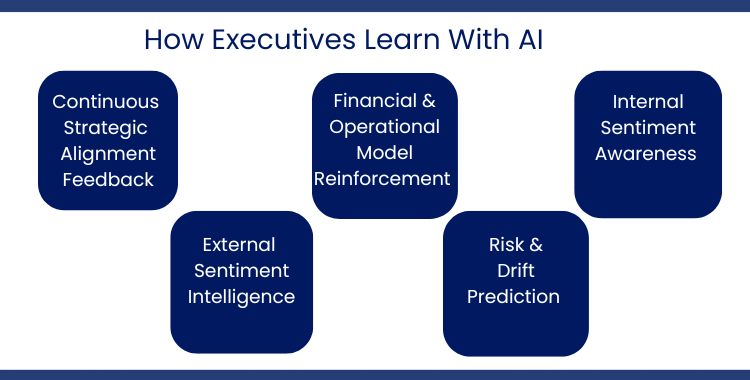
- Through Continuous Strategic Alignment Feedback
Executives set strategic goals — revenue, margin, efficiency, expansion, retention, quality, risk appetite.
Executive Agents continuously track:
- What decisions support the strategy
- What decisions conflict with it
- Where execution is aligned
- Where drift has begun
- What leading indicators are shifting
- Which KPIs show early friction
- Which sentiment signals imply resistance
Executives begin to see the “cause and effect” of their decisions faster.‑and‑effect” of their decisions faster.
The AI learns:
“This is the pattern of decisions the CEO values.”
The executive learns:
“This is how strategy behaves in real time.”
- Through Financial & Operational Model Reinforcement
Executive Agents constantly evaluate decisions against financial and operational goals:
- revenue → is it accelerating or stalling?
- margin → strengthening or eroding?
- cost → one-time or systemic?
- throughput → consistent or uneven?
- quality → rising or slipping?
Executives begin to internalize new patterns:
- What signals precede a margin dip
- What decisions tend to improve efficiency
- What tradeoffs yield the best ROI
- How operational changes ripple into financial outcomes
The AI learns how the executive makes financial tradeoffs.
The executive learns how the environment behaves under different pressures.
This is bi-directional intelligence growth.
- Through Internal Sentiment Awareness
This is the signal most executives miss — and where most strategies break.
Executive Agents monitor:
- Team morale
- Workload stress
- Tone of communication
- Meeting friction
- Project sentiment
- Cross-functional tension
- Leadership trust signals
- Emerging confusion or misalignment
Executives begin to see patterns between:
- sentiment → execution
- execution → performance
- performance → financial outcomes
This is where the AI becomes an extension of the leader’s emotional radar.
- Through External Sentiment Intelligence
Executive Agents analyze:
- customer tone
- support interactions
- reviews
- churn indicators
- market chatter
- competitive moves
- social dynamics
Executives begin to see how decisions land externally and how the market responds to:
- product changes
- experience improvements
- pricing adjustments
- announcements
- operational hiccups
Executive Agents become a strategic edge — exposing signals a leader could never see at the human scale.
- Through Risk & Drift Prediction
Executive Agents don’t wait for outcomes.
They monitor early signals of:
- KPI drift
- data drift
- process drift
- priority drift
- sentiment drift
- revenue drift
- compliance risk
- reputational risk
- execution friction
Executives begin learning natural drift patterns in their organization.
AI learns which risks each leader treats as urgent.
Together, they create a shared risk model that improves over time.
The Moment AI Becomes an Extension of the Executive

There is always a moment — often quiet, often surprising — when leaders realize their Executive Agent has become:
- their extra set of eyes,
- their early warning system,
- their strategy translator,
- their pattern detector,
- their alignment enforcer,
- their decision co‑thinker.
Executives report moments like:
- “It flagged something I hadn’t noticed yet.”
- “It knew the decision I was leaning toward.”
- “It understood the tradeoff I was weighing.”
- “It caught drift before it became a problem.”
- “It mirrored how I think, but with better data.”
- “It gave me visibility I didn’t know I needed.”
- “It extends my leadership the way an incredible chief of staff would.”
That’s the point:
Executive Agents extend leadership. They don’t replace it.
Conclusion: When AI Extends Leadership, Performance Follows
👉 Ready to lead smarter?