

Introduction
Agentic AI is no longer confined to innovation labs and pilot projects. It’s quietly creeping into day-to-day work. Sales teams are experimenting with outbound agents, operations teams are building workflow bots, finance teams are testing forecasting copilots, and individual contributors are wiring up their own automations.‑to‑day work: sales teams experimenting with outbound agents, operations teams building workflow bots, finance teams testing forecasting copilots, and individual contributors wiring up their own automations.
On the surface, this looks like progress. Underneath, it’s starting to look like something else:
A dense, tangled agent jungle — full of overlapping tools, duplicated functions, unknown access paths, and no clear lines of ownership.
For CEOs, CFOs, CPAs, CIOs, and CTOs, this is a serious risk. Every new agent represents:
- A new way to touch sensitive data
- A new path into core systems
- A new set of decisions and actions that no one may be fully watching
The problem isn’t that people are experimenting with AI. The problem is uncontrolled sprawl: agents popping up everywhere without consistent standards, governance, or visibility.
This guide explains what the internal agent jungle looks like, the five main causes of internal agent sprawl, and how leadership can regain control without crushing innovation.
What Is the Internal “Agent Jungle”?
The internal agent jungle is what happens when individual teams and employees:
- Spin up their own AI agents
- Connect them to critical systems
- Automate more and more steps
…without any central visibility or standards.
You’ll recognize it by symptoms like:
- No one can answer “How many agents do we have, and what do they do?”
- Different teams build agents for the same process, with different logic
- Access to data and systems is based on convenience, not principle
- When something goes wrong, it’s unclear which agent was responsible
In this environment, small misconfigurations can cascade into large operational, financial, or compliance incidents — especially when agents touch customer data, financial records, or regulated processes.
The agent jungle doesn’t appear overnight. It grows from five specific causes.
The 5 Causes of Internal Agent Sprawl
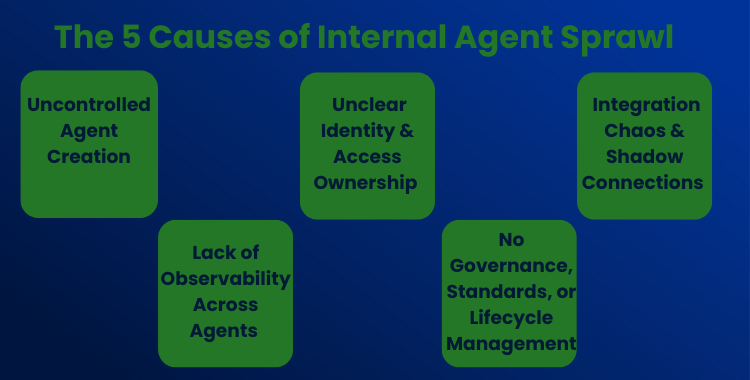
- Uncontrolled Agent Creation
In many organizations, anyone can create or adopt an AI agent: a prebuilt bot from a vendor, an internal script, a no code automation from a power user built bot from a vendor, an internal script, a no code automation from a power user.‑built bot from a vendor, an internal script, a no‑code automation from a power user.
At first, this looks like a grassroots innovation. But without boundaries, you end up with:
- Many agents doing similar things
- No centralized inventory
- No record of which business processes are being automated
Uncontrolled creation is how your environment fills up with agents that no one even remembers building — until something breaks.
- Unclear Identity & Access Ownership
In a healthy environment, every agent is treated like a digital worker: it has a distinct identity, a well-defined role, and clear permissions. In an agent jungle, the opposite happens:‑defined role, and clear permissions. In an agent jungle, the opposite happens:
- Shared credentials are used “just for now”
- Agents inherit human level access they don’t need level access they don’t need‑level access they don’t need
- No one knows exactly which systems any given agent can touch
When identity and access ownership are unclear, it’s almost impossible for executives, security teams, CPAs, or auditors to answer basic questions like:
- “Which agents can touch our GL or ERP?”
- “Who approved this agent’s access to customer data?”
That’s not a technology limitation — it’s a governance gap.
- Integration Chaos & Shadow Connections
Agents are useful because they connect systems: CRM, ERP, finance, HR, ticketing, data warehouses, and collaboration tools. But when those connections are created ad hoc, you get integration chaos:
- Unapproved connectors into sensitive systems
- Direct access into production databases from experimental agents
- Fragile point-to-point ties that no one has documented ‑to‑point ties that no one has documented
From a risk perspective, every shadow integration is:
- A potential data exfiltration path
- A potential integrity issue (incorrect updates to core systems)
- A potential outage trigger if something loops or fails badly
When integration is chaotic, even the best AI strategy is deployed on an unstable surface.
- Lack of Observability Across Agents
You can’t manage what you can’t see. In an agent jungle, there is no consolidated view of:
- Which agents are running
- What they are doing
- When they are active
- Where they are writing data
- How often they fail or trigger exceptions
Instead, logs — if they exist — are scattered across tools, or not enabled at all. When something goes wrong, teams scramble to reconstruct:
- Which agent executed the action
- What logic or prompt it used
- Which inputs it saw
For executives, CPAs, and auditors, this is unacceptable. Without observability, you are effectively blindfolded while automation is running in the background.
- No Governance, Standards, or Lifecycle Management
Finally, internal agent jungles thrive where there is no clear:
- Policy for proposing and approving new agents
- Standard for design, testing, and change management
- Criteria for when an agent should be retired or replaced
- Defined owner responsible for monitoring performance and risk
Agents get deployed, forgotten, and left running indefinitely. There is no sunset process. No periodic review. No structured lifecycle.
In that environment, AI is not a capability. It’s an uncontrolled experiment running on your production business.
Why the Agent Jungle Is a C-Suite Problem
It might be tempting to see all of this as a technical or operational issue — something IT or middle management can sort out.
That would be a mistake.
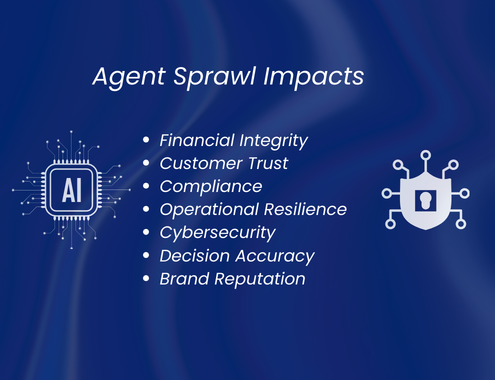
Internal agent sprawl directly impacts:
- Financial integrity (CFO, CPA)
- Operational resilience (COO)
- Risk and compliance (CRO, General Counsel, Internal Audit)
- Customer experience and brand trust (CEO, CMO)
If agents can touch money, customers, or regulated data, the board will eventually ask:
“How do we know we’re in control of this?”
To answer confidently, the C-Suite must treat the agent jungle as a strategic risk and a strategic opportunity — and commit to taming it.
Your First Steps to Tame the Internal Agent Jungle

You don’t have to shut everything down to regain control. But you do need to act deliberately. A pragmatic starting point:
- Inventory what already exists
- Ask each business unit to identify agents and automations in use
- Capture purpose, systems touched, and owners
- Stop the bleeding
- Introduce a simple, interim approval process for new agents
- Require unique identities and least privilege access for any new deployment privilege access for any new deployment‑privilege access for any new deployment
- Define the non-negotiables‑negotiables
- Clarify which systems or data cannot be accessed by unsanctioned agents
- Set expectations for logging, monitoring, and human oversight
- Design your future operating model
- Decide who owns the AI portfolio (e.g., an AI council or center of excellence)
- Define standards for design, testing, rollout, and review
From there, you can evolve toward a more mature, centralized model for managing agents as first-class digital workers — with the same rigor you apply to human staff and critical systems.‑class digital workers
Conclusion
The internal agent jungle isn’t a sign that things have gone wrong — it’s a sign that AI has escaped the lab and entered the real business.
Whether that becomes a competitive advantage or a serious liability depends on how quickly leadership:
- Recognizes the five causes of agent sprawl
- Accepts joint accountability across the C-Suite
- Puts in place inventory, access control, integration standards, observability, and governance
The good news: with the right structure, you don’t have to choose between innovation and control. You can have both.
For additional content on AI risk management and auditability check out our blogs: Secure AI Adoption in Microsoft 365, and Designing Auditable AI: How to Make Every Agent Action Traceable.
Need assistance controlling your agents, we can help with technology readiness assessments, AI Agent inventory, and governance.
Agentic AI Sprawl Control Blueprint
Agent sprawl is becoming a silent threat in mid‑market and enterprise organizations.